
Skin Basics · 5 min read
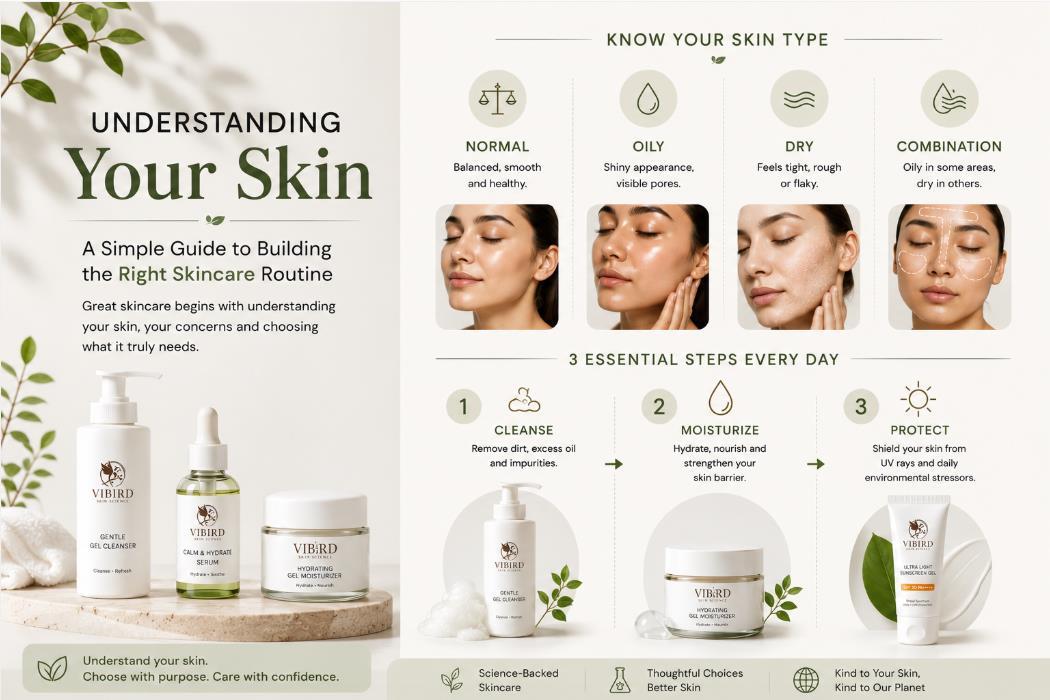
Understanding Your Skin: A Simple Guide to Building the Right Skincare Routine
Better skincare choices begin with understanding what your skin actually needs.
Your skin is unique. How it feels and behaves can be influenced by natural oil production, moisture, environment, lifestyle, age and the products you use.
That is why understanding your skin is one of the most useful first steps in skincare.
Once you know your skin type, recognize your main concerns, and understand what basic skincare products are designed to do, choosing a routine becomes much simpler.
This guide will help you understand those essentials—simply, practically and with science in mind.
1. Start by Understanding Your Skin Type
Skin type generally describes how your skin naturally behaves, particularly in relation to oil and moisture.
Normal Skin
Usually feels reasonably balanced—neither excessively oily nor excessively dry.
Oily Skin
Produces more sebum, the natural oil made by the skin. It may appear shiny, particularly around the forehead, nose and chin.
Dry Skin
Tends to have less natural oil and may feel tight, rough or flaky.
Combination Skin
Shows characteristics of more than one skin type—for example, an oilier T-zone with normal or drier cheeks.
What About Sensitive Skin?
Sensitivity is slightly different.
Dry, oily, normal or combination skin can also experience sensitivity or increased reactivity to certain products or environmental factors.
So rather than relying only on a label, pay attention to how your skin actually behaves.
2. Skin Type and Skin Concern Are Different
This is an important distinction when choosing skincare.
Your skin type describes the general characteristics of your skin.
Your skin concern is something specific you would like to address or support.
For example:
- Oily skin + clogged pores
- Dry skin + dullness
- Combination skin + uneven tone
- Normal skin + early signs of ageing
Two people can therefore have the same skin type but need very different routines.
Before choosing a new skincare product, ask yourself two simple questions:
What is my skin type?
What is the main concern I want to address?
Knowing the answers can make product selection much more purposeful.
3. Build Your Routine Around Three Essentials
Skincare does not have to begin with many different products.
For most people, a sensible foundation can be built around three basic functions:
CLEANSE
Cleansing helps remove excess oil, sweat, dirt, sunscreen and everyday buildup from the skin.
A good cleanser should clean effectively while leaving the skin feeling comfortable rather than excessively dry or tight.
MOISTURIZE
Moisturizers help maintain hydration, softness and support the skin's protective barrier.
The texture can be chosen according to your skin and preference. Someone with oily skin may enjoy a lightweight gel or lotion, while drier skin may feel more comfortable with a richer formulation.
And remember:
Oily skin can still need hydration.
Oil and water are not the same thing.
PROTECT
During the day, sunscreen helps protect the skin from harmful ultraviolet (UV) radiation.
UV exposure contributes to sunburn, premature skin ageing and pigmentation changes and increases the risk of skin cancer.
A broad-spectrum sunscreen with appropriate SPF protection is therefore an important part of a daytime skincare routine.
The best sunscreen for everyday use is also one that you are comfortable applying correctly and consistently.
4. When Should You Add Serums or Active Ingredients?
Once the basics are in place, additional products can be selected according to a specific need.
Ingredients such as niacinamide, salicylic acid, vitamin C, retinoids, hyaluronic acid and ceramides have different functions in skincare.
But seeing a popular ingredient does not automatically mean your skin needs it.
A useful principle is:
Concern first. Ingredient second.
For example, an ingredient used for hydration serves a different purpose from one intended to support clogged-pore-prone skin or improve the appearance of uneven pigmentation.
The concentration of an ingredient is also only one part of the story. The complete formulation, stability, combination of ingredients and how your skin responds all matter.
Introduce new products thoughtfully and give your skin time to respond.
5. Your Skin Doesn't Exist in Isolation
Good product selection also considers your everyday environment.
Heat, humidity, cold weather, air-conditioning, sun exposure, sweating and lifestyle can all influence how your skin feels and how comfortable a skincare product is to use.
For example, lightweight textures may feel more comfortable for some people in hot and humid conditions, while richer formulations may be preferred when the skin or environment is particularly dry.
Skincare therefore isn't simply about asking:
"Is this a good product?"
A better question is:
"Is this a good product for my skin, my needs and my lifestyle?"
Listen to Your Skin
Your skin can change with seasons, environment, age, lifestyle and other factors. Your routine may need to change with it.
Pay attention to how your skin responds. Introduce new products carefully, use them as directed, and avoid assuming that using more products—or higher concentrations—will necessarily produce better results.
Cosmetic skincare can support cleansing, hydration, protection and the appearance and condition of the skin, but it is not a substitute for medical diagnosis or treatment.
Persistent, severe, painful, rapidly changing or otherwise concerning skin problems should be assessed by an appropriately qualified healthcare professional.
Good Skincare Starts With Understanding
There is no single skincare routine that is perfect for everyone.
A better starting point is simple:
Understand your skin.
Identify what it needs.
Choose with purpose.
Use consistently.
Adjust when your skin tells you to.
At Vibird, we believe better skincare decisions begin with better understanding.
Our aim is to make skincare easier to understand so that people can make informed, responsible and confident choices for their skin.
Understand Your Skin. Choose With Purpose.
*This article is provided for general skincare education and is not intended to diagnose, treat, cure or prevent any medical condition.